Dawn breaks with a mighty roar
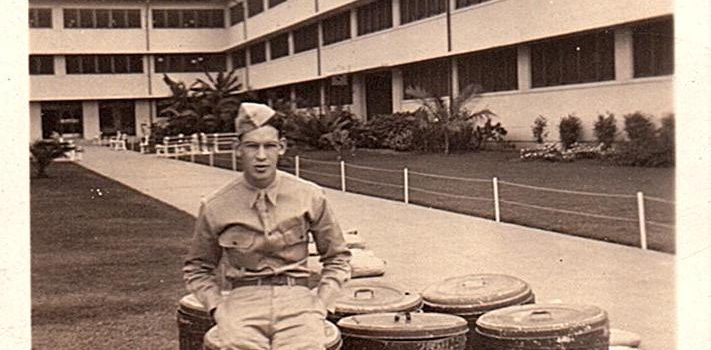
Lakeland Ledger theater writer Brad Beahan experienced the attack on Pearl Harbor as a 21-year-old private in the Army Air Corps stationed at Hickam Field, adjacent to Pearl. The story is a first-hand account of Beahan’s experiences and observations the day Pearl Harbor was attacked.
By Brad Beahan
Sept. 7, 1991
The dawn breaks cool and soft on a December morning in Hawaii just as it does in Central Florida. It is for many and for thousands of others on the Island of Oahu on the morning of Dec. 7, 1941, the date that was to become known as “a day which will live in infamy.”
At 7:55 on that Sunday morning I was asleep in the lower bay of the big concrete barracks across the street from the flight line at the Army Air Corps’ Hickam Field. This was the bomber base that sits a fence-line away from Pearl Harbor. At the entrance to Hickam, you could stand with one foot on Army ground and the other on Navy.
Hickam was the home of two medium bomber groups, the 5th and 11th, and a squadron of mean-looking, twin-engine attack bombers, plus a host of support units of all kinds. It was also the home of the Hawaiian Air Force.
I was a private in Group operations of the 11th Bombardment Group that was in the process of converting from 2-engine B-18s to the new heavy bomber, the 4-engine Boeing B-17. This plane later became the most famous bomber of all time.
Explosions and the sound of low-flying airplanes woke me up on that Sunday morning. I was not in the best of shape. The previous evening I was down in Waikiki trying, unsuccessfully, to romance the carhop girls at the drive-in restaurant in Kapiolani Park.
It sounded like war games
It was futile but harmless entertainment, but probably better than risking a dose of clap at the cut-rate ($2 vs. $3) Honolulu Rooms in the famous red-light district of Honolulu.
I thought the Sunday morning noise was a combination of practice firing by the big guns at Fort Kamehamea at the end of Hickam on the channel leading into Pearl, plus a simulated war exercise by Navy carrier planes. Both events were not uncommon in the islands at that time.
At that moment, Corp. Kay B. Steele, a former farm boy from Idaho and a friend and fellow worker of mine, came rushing into the barracks hollering, “It’s the goddamn Japs.”
By this time the explosions were coming fast and loud, not real close but shaking the ground. We still didn’t know just what was going on, but it was plain that we were under an air attack.
I made my own priorities
I didn’t know what to do. I can’t remember getting any prior briefings on the possibility of an attack by the Japanese or anybody else, so it all came as a surprise to me. In the army you learn to wait for some authority figure, a sergeant or an officer, to tell you where to go and what to do. I could see this was not going to happen this day, so I made my own priorities.
Later, there were tons of books and articles, all full of hindsight, on what our leaders knew and should have done, but I was at the bottom of the information chain and dumb as a stone. All I could think of that day was survival.
The barracks were not under attack at that time. But bombs were falling on the hangars and planes parked out on the ramp. Pearl was being hit hard.
As I watched all this, I thought: I gotta get out of here. My first instincts were to report to my place of duty at the Base Operations building on the flight line, so, when a lull came in the attack, I ran for it. That decision probably saved my life.
All hell was breaking loose over at Pearl. Huge explosions sent columns of black smoke towering into the air. The sky seemed full of planes. After the attackers dropped their loads at Pearl, they came streaking across Hickam firing machine guns at everything in sight.
The attacks came in waves, and, after I got to Base Operations, the second wave at Hickam hit the barracks where I had just been. Many of my squadron mates were killed or wounded in that attack.
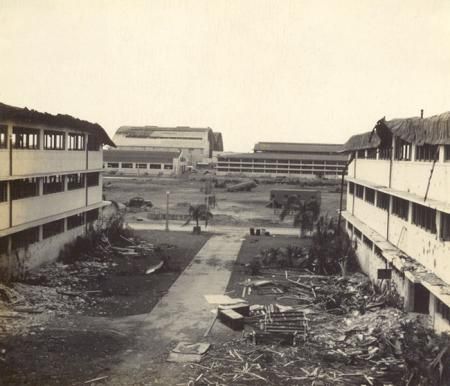
The bombs that didn’t hit the barracks directly fell outside and created an implosion effect that sent a hail of mortar and bricks through the barracks that became in themselves lethal projectiles.
In these few minutes, my squadron took 55 percent casualties. At least 15 were killed outright and dozens were wounded. A blond kid named Howard who slept in the bunk next to me was killed. A sergeant friend of mine named Chapman across the aisle met the same fate.
Many of the casualties came when men crowded into the big entranceway to try to see what was going on. Two big bombs, probably 500 pounders, hit on each side of the doorway and killed everybody in front and wounded most of those behind.
Our squadron was one of the hardest hit of any at Hickam, and I never saw many of the men I had served with after that day.
Meanwhile, I was crouched in a hallway away from the windows at the Operations building. Next to me was a Navy pilot who had the bad luck of being en route from the carrier Enterprise to Ford Island, the air field in the center of Pearl Harbor.
He told me he couldn’t get into Ford—it was blasted and burning—so he tried to land at Hickam. Friendly antiaircraft shot him down on final approach. He crash landed and walked away unhurt.
Planes were sitting ducks
He was understandably bitter. He told me. “The first day of the war and I get shot down by my own people.”
I often wonder if he survived the war, and, if he did, what he tells his grandchildren about his brief role on that fateful day. War stories tend to take on a life of their own, and I wouldn’t be surprised if he didn’t even claim to have sunk the Japanese battleship Haruna for the umpteenth time during the long war that followed.
During the attack, 12 B-17Es, the latest version of this great airplane were coming into Hickam from Hamilton Field on the West Coast. They were on their way to the Philipines. They had guns but no ammunition and were sitting ducks for the Japanese attackers. The bombers landed anywhere they could, on short fighter strips, one even landed on a golf course.
Miraculously, although many crewmen were wounded, only one officer, a flight surgeon, was killed. They all got in more or less safely. Some crash landed and all were damaged.
I saw one of the incoming B-17s get hit with a bomb just as it touched down at Hickam. The plane broke in half back of the radio compartment and skidded off the runway. The crew survived, some wounded, all badly shaken but intact.
I also remember watching the first attempt to take a plane off Hickam after the attack. It was a B-17C or D, loaded with 500-pound bombs. It began its roll, but the tail, instead of staying low in take-off position, started to elevate and the plane seemed almost out of control. The pilot, Allen Sewart, who later was to become a hero and died in the Solomons, fought it all the way and finally ground-looped it off the runway. It came safely to a stop, but its day was done. It was later learned the control locks on the elevator and tail had not been removed. So much for retaliation.
When the attack appeared over the thought uppermost in everybody’s mind was whether the Japanese were going to invade and take over the islands. The group commander thought it advisable to safeguard the service records of the men, so he told the operations officer to have someone take the records up into the hills behind Honolulu. Nothing was said about what would be done with them. The plan hadn’t gotten that far yet.
Looking like deserters
Because another soldier, Willie Rathbun, and I were the lowest-ranking guys in the room, we got the job. The records were in a foot-locker that weighted 80-100 pounds. There was no transportation, so we picked up the trunk and started for the hills. We tried to hitchhike but nobody was going to pick up a couple of dogfaces with a trunk. We probably looked like deserters, bugging out.
We hadn’t gone far before we realized we were never going to make it to the hills. We were still on the base. We came to a lumberyard that looked to us like a good place to hole up and assess the situation. We stayed there the rest of the afternoon, talking over what we were going to tell the officers on the court martial board when we were tried for dereliction of duty.
As sundown approached, we took a vote and it was unanimous. We were going back, find our unit and find out what the hell was going on. We were out of touch and very nervous. We picked up the trunk and headed back to the Army.
A couple of hours later we found our outfit. They were about to declare us missing in action. They thought we had been killed in the attack. Nobody remembered or cared about our orders to head for the hills. One thing was sure, we weren’t going to jail.
And so ended what had to be the longest day of our lives.
Epilogue
Willie and I later went to the South Pacific with the 11th Bomb Group and participated in the first big offensive of the Pacific war, the battle for Guadalcanal in the Solomon Islands in 1942.
We both became master sergeants and went on with the group in B-24s in the Marshall and Gilbert Islands campaigns.
After more than four years in the Pacific, we came home. Willie went back to his farm in upper New York state. I went to Syracuse University, got a degree, was recalled back into the Air Force, served in the Korean War and flew 137 missions in spy planes during the Vietnam War out of Danang. I retired as a major in 1968.